If you’ve been planning a trip to Europe and keep seeing headlines about “ETIAS,” you’re not alone — and you’re right to pay attention. The European Travel Information and Authorisation System has been delayed repeatedly since it was first proposed, and as of mid-2026 its status has changed again. This guide covers exactly where things stand, who will need ETIAS, what it costs, and how to prepare — without the confusion.
1. What Is ETIAS?
ETIAS is not a visa. It’s an online pre-travel authorization, similar to the US ESTA system, required for citizens of visa-exempt countries who want to enter the Schengen Area for short stays.
Key facts about the system:
- Not a visa — it’s an electronic authorization linked to your passport.
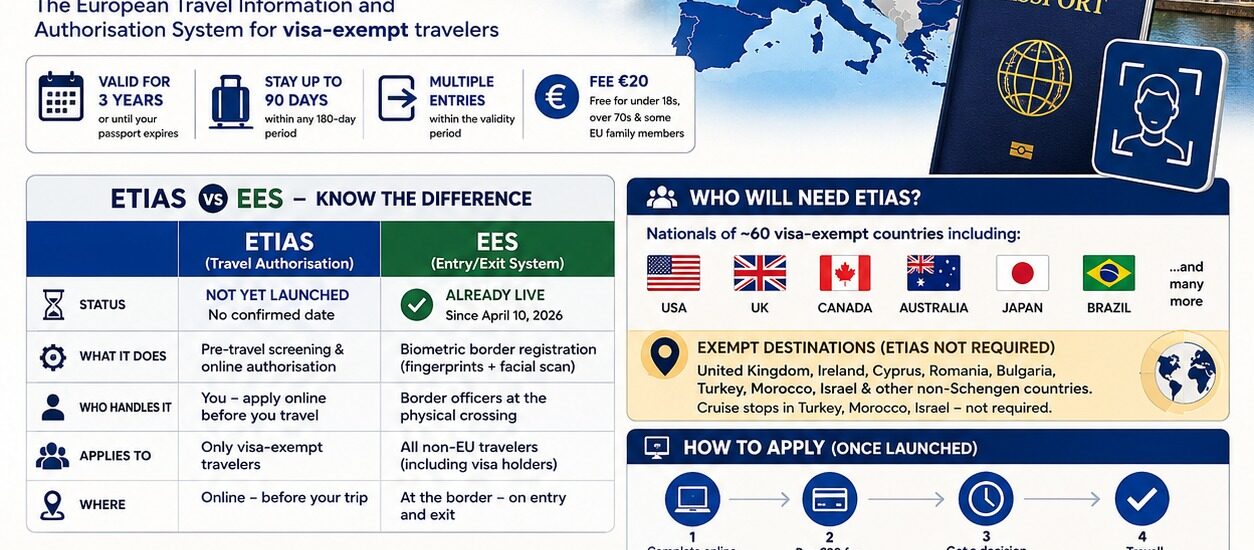
- Validity: Valid for three years or until your passport expires, whichever comes first.
- Stay limit: Allows stays of up to 90 days within any 180-day period, with unlimited entries during that time.
- Fee: €20 per application, revised up from the originally proposed €7. Children under 18 and adults over 70 are exempt from the fee, along with some family members of EU citizens, though an authorization is still required.
- Coverage: Applies to visa-exempt travelers — including UK, US, Canadian, and Australian passport holders — visiting 30 European countries for short stays, covering every EU country except Ireland, plus Iceland, Norway, Liechtenstein, and Switzerland.
2. When Is ETIAS Actually Launching? (The Real Answer)
This is the part where a lot of outdated articles get it wrong. Here’s the current state of play as of late July 2026:
The official EU travel authorization website has removed its previous late-2026 target and now simply states that the EU will announce a start date several months before the system goes live. This followed reporting that ETIAS is likely to be delayed until 2027, after eu-LISA — the EU agency developing the system — reportedly concluded that a 2026 launch was no longer feasible.
Why the delay? The setback is tied to ongoing problems with the Entry/Exit System (EES), which ETIAS is meant to follow, along with “still some IT issues” with ETIAS itself — with one person familiar with the discussions arguing that the EES should be stabilized before adding another system that could worsen border queues.
That said, not everyone at the EU is pessimistic: one EU official suggested any delay would likely be brief, requiring only an extra quarter or month, and the eu-LISA management board was expected to meet again in September to consider a revised timeline.
Bottom line: There is currently no confirmed launch date. Don’t trust any website that gives you an exact “go-live” date in 2026 — treat it as speculative until the European Commission makes an official announcement.
3. Don’t Confuse ETIAS with EES — They’re Different Systems
This is the most common source of confusion, and it matters right now because one of these systems is already live.
|
EES (Entry/Exit System) |
ETIAS |
|
|
Status |
Already live since April 10, 2026 |
Not yet launched — no confirmed date |
|
What it does |
Biometric border registration (fingerprints + facial scan) on every Schengen entry and exit |
Pre-travel screening and authorization applied for online, in advance |
|
Who handles it |
Border officers at the physical crossing — you don’t apply in advance |
You, via an online form before you travel |
|
Applies to |
All non-EU travelers, including those who need a visa |
Only visa-exempt travelers |
So if you’ve recently had your fingerprints or face scanned at a European border, that was EES, not ETIAS — the EES became fully operational at all external border crossing points of participating European countries from April 10, 2026.
4. Who Will Need ETIAS?
Once launched, ETIAS will apply to nationals of roughly 60 visa-exempt countries, including:
- United States
- United Kingdom
- Canada
- Australia
- New Zealand
- Japan
- Brazil
- And most other countries that currently enjoy visa-free short-stay access to the Schengen Area
Who is exempt or unaffected:
- Travelers to countries outside Schengen — including the United Kingdom, Ireland, Cyprus, Romania, Bulgaria, Turkey, Morocco, and Israel — will not need ETIAS for those destinations.
- Cruise passengers should note that non-Schengen Mediterranean stops such as Turkey, Morocco, and Israel will not require ETIAS, though every Schengen port stop will once the system is mandatory.
- EU citizens and holders of existing long-term visas/residence permits are not affected.
5. What Happens at Launch: The Rollout Phases
Even once a launch date is confirmed, ETIAS won’t become instantly mandatory everywhere. Expect a phased rollout:
- Transition period: A transition period of at least six months is planned, during which travelers should apply, but those without ETIAS will not be refused entry if they meet all other requirements.
- Airline checks begin: During this window, airlines will be required to verify ETIAS status before boarding, with carriers facing penalties for transporting non-compliant passengers — so relying on border-level flexibility is riskier than it sounds, since you could be denied boarding at check-in.
- Full enforcement: After the transition period ends, ETIAS becomes strictly mandatory with no discretion for non-compliant travelers.
6. How the Application Process Will Work
Based on the EU’s published plans, applying for ETIAS is designed to be simple:
- Complete an online form through the official ETIAS website or mobile app, providing passport and personal details and answering security screening questions.
- Pay the €20 fee (waived for under-18s, over-70s, and some family members of EU citizens).
- Wait for a decision. Most applications are expected to be approved within minutes, though some will take longer — decisions are expected within four days, extending to 14 days if additional documents are needed, or 30 days if an interview is required.
- Travel with your ETIAS linked electronically to your passport — no physical document or stamp is needed.
Important: ETIAS will not guarantee entry — border guards will still verify passports, documents, and entry conditions, and may refuse admission even with a valid, approved ETIAS.
7. What Travelers Should Do Right Now
For now, travelers do not need to take any action, and the EU has confirmed that no applications are being accepted yet. A few practical takeaways:
- Don’t pay anyone for an ETIAS application today. Officials have specifically warned against using unofficial third-party websites while ETIAS remains unavailable — any site charging you now is not legitimate.
- Current entry rules still apply. Travelers can continue visiting Schengen countries under existing visa-free requirements.
- Expect biometric checks at the border if you haven’t already experienced them — this is EES, already in effect, not ETIAS.
- Keep an eye on the official EU travel website rather than third-party “countdown” sites, since the launch date is genuinely unconfirmed and subject to change.
- Once a date is announced, plan to apply at least a few weeks before departure, even though most approvals are expected within minutes — this leaves room for the rare case that needs manual review.
Conclusion
ETIAS is coming, but — despite years of confident “Q4 2026” headlines — the truth right now is that the EU has walked back its own timeline and no longer commits to a specific launch window. The system it depends on, EES, is live and already collecting biometric data at the border, but ETIAS itself remains unlaunched, with a 2027 start looking increasingly plausible. Until an official date is confirmed, no action is required — just keep booking, keep traveling under existing visa-free rules, and check the official EU site periodically for updates rather than relying on projected dates from other travel blogs.
This guide reflects the most recent publicly reported status as of late July 2026. Because the launch timeline is actively changing, always verify the current status on the official EU travel authorisation website before making travel decisions based on ETIAS.