If you’re planning a trip to Europe, you’ve probably come across both “Schengen visa” and “ETIAS” in your research — and it’s easy to assume they’re the same thing, or that one replaces the other. They don’t, and it doesn’t. These are two completely separate systems designed for two different groups of travelers. Getting this wrong can mean applying for the wrong thing, missing a deadline, or showing up at the airport without the right paperwork.
This guide breaks down exactly how they differ, who needs which one, and where things currently stand.
1. The Core Difference in One Sentence
- A Schengen visa is a pre-approved permission to travel, required if your nationality does not have visa-free access to Europe.
- ETIAS is a lightweight travel authorization, required if your nationality already has visa-free access to Europe.
In other words, they apply to two entirely different groups of people. If you currently need a visa to visit Europe, ETIAS does not change that — you’ll still need a Schengen visa. ETIAS only affects travelers who could already enter Europe without one.
2. Schengen Visa: The Basics
A Schengen visa lets you visit the Schengen Area’s participating European countries for up to 90 days in any 180-day period. It’s a formal visa application process, not a quick online form.
Main visa types:
- Type A (Airport Transit Visa) — for travelers passing through the international transit area of a Schengen airport without entering the country.
- Type C (Short-Stay Visa) — the standard visa for tourism, business, family visits, or short-term study, allowing stays of up to 90 days within a 180-day period, with single, double, or multiple entry options.
- Type D (Long-Stay/National Visa) — for stays longer than 90 days, typically for work, study, or residency in a specific Schengen country.
Cost: The standard Schengen visa fee is €90 for adults, €45 for children aged 6-12, and free for children under 6.
Processing time: Typically around 15-20 working days, though it can take up to 45 days if additional scrutiny is required — applicants are advised to apply at least 45-60 days before their planned travel date.
What you’ll need:
- A completed application form and valid passport
- Mandatory travel medical insurance, typically with minimum €30,000 coverage valid across the Schengen Area, including repatriation and medical evacuation.
- Proof of accommodation, financial means, and travel itinerary
- An application submitted at the embassy or consulate of your main destination country — applying to the wrong country’s embassy is one of the most common reasons for delays or rejection.
- In many cases, biometric data (fingerprints) collected in person at a visa application center
3. ETIAS: The Basics
ETIAS (European Travel Information and Authorisation System) is a much lighter-touch process — it’s not a visa at all, but an electronic pre-travel screening.
Cost: €20 per application, with children under 18 and adults over 70 exempt from the fee (though still required to have an approved authorization).
Validity: Valid for three years or until your passport expires, whichever comes first, allowing unlimited entries during that time.
Stay limit: Same 90 days within any 180-day period as the Schengen visa.
Processing time: Most applications are expected to be approved within minutes, though some may take up to four days, extending to 14 days if extra documents are needed, or 30 days if an interview is required.
What you’ll need:
- An online form with passport and personal details, completed via the official website or app
- Answers to basic security screening questions
- No in-person appointment, no biometric collection, no embassy visit
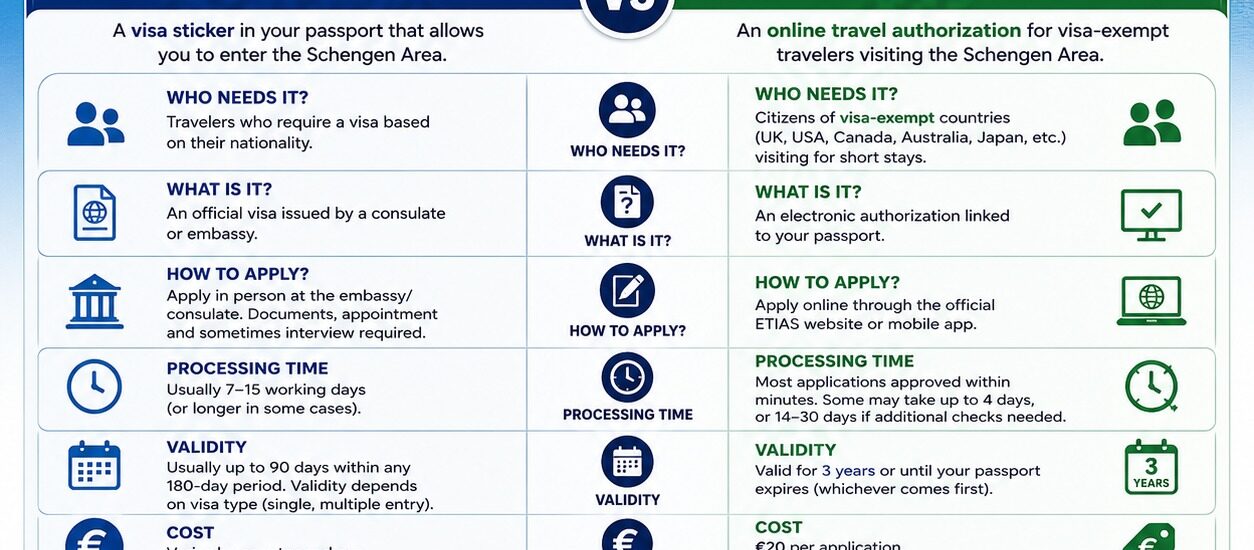
4. Side-by-Side Comparison
|
Schengen Visa |
ETIAS |
|
|
What it is |
A formal visa |
An online travel authorization (not a visa) |
|
Who needs it |
Nationals of countries without visa-free access to Europe |
Nationals of visa-exempt countries (US, UK, Canada, Australia, etc.) |
|
Application method |
In-person at embassy/consulate or visa application center |
Fully online, no appointment |
|
Cost |
€90 for adults, €45 for children 6-12, free under 6 |
€20, waived for under-18s and over-70s |
|
Processing time |
~15-20 working days, up to 45 in complex cases |
Minutes to a few days for most; up to 30 days in rare cases |
|
Validity |
Set per visa (single, double, or multiple entry) |
3 years or until passport expires |
|
Biometrics required |
Yes, typically fingerprints at application |
No |
|
Stay limit |
Up to 90 days per 180-day period |
Up to 90 days per 180-day period |
|
Launch/availability status |
Already in effect |
Delayed — no confirmed launch date as of mid-2026 |
5. Where Things Stand With ETIAS Right Now
This is the part travelers most often get wrong, because ETIAS has been talked about for years while continuously slipping.
The official EU travel authorisation website has removed its previous late-2026 launch target and now simply states that a start date will be announced several months before the system goes live, following reports that ETIAS is likely delayed until 2027. For now, no ETIAS applications are being accepted, and officials have warned against using unofficial third-party websites claiming to process applications early.
Meanwhile, a related but separate system — the Entry/Exit System (EES) — is already active. The EES became fully operational at all external border crossing points of participating European countries from April 10, 2026. EES handles biometric registration (fingerprints and facial scans) at the physical border; it is not ETIAS and does not require you to apply in advance.
Practical takeaway: If your nationality is visa-exempt, you currently still travel to Europe exactly as you always have — no ETIAS application exists yet. Watch for biometric checks at the border (that’s EES), but don’t pay for or apply through any site claiming to offer ETIAS today.
6. Which One Do You Need?
Use this quick check:
- Does your passport currently require a visa to enter Europe for short trips?
- Yes → You need a Schengen visa. ETIAS does not apply to you and will not replace this requirement.
- No (e.g., you’re a US, UK, Canadian, Australian, Japanese, or other visa-exempt national) → You currently need nothing extra to enter for short stays. Once ETIAS launches, you will need to apply for it online before future trips — but there’s no action to take yet.
Conclusion
The simplest way to remember the difference: a Schengen visa is a full visa application process for travelers whose nationality doesn’t already have visa-free access to Europe, while ETIAS is a lightweight, online-only authorization for travelers who already enjoy visa-free access and just need to register in advance. One requires an embassy visit, biometrics, and a real approval process; the other is designed to take minutes online. Right now, only the Schengen visa is actually operational — ETIAS remains delayed with no confirmed launch date, so visa-exempt travelers can keep booking trips under the current rules until an official announcement changes that.
Visa and travel authorization rules can change. Always confirm current requirements with the embassy or consulate for your destination, or the official EU travel authorisation website, before finalizing travel plans.