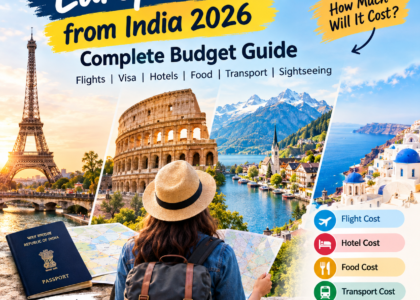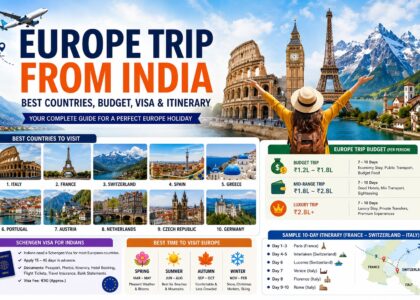
Planning a Europe trip from India but confused about how much money you actually need? Your total Europe travel cost depends on your flights, accommodation, food, transportation, number of countries, travel season and the experiences you choose.
For Indian travellers, three practical budget levels are:
₹1.5 lakh — Budget Europe Trip
₹2.5 lakh — Comfortable Europe Trip
₹4 lakh — Premium Europe Trip
This guide explains what you can realistically expect at each budget and how to divide your money between flights, hotels, food, transport, sightseeing, visa and other expenses.
Important: These are planning estimates, not fixed prices. Airfares, hotel rates, exchange rates and attraction prices can change significantly by destination and season.
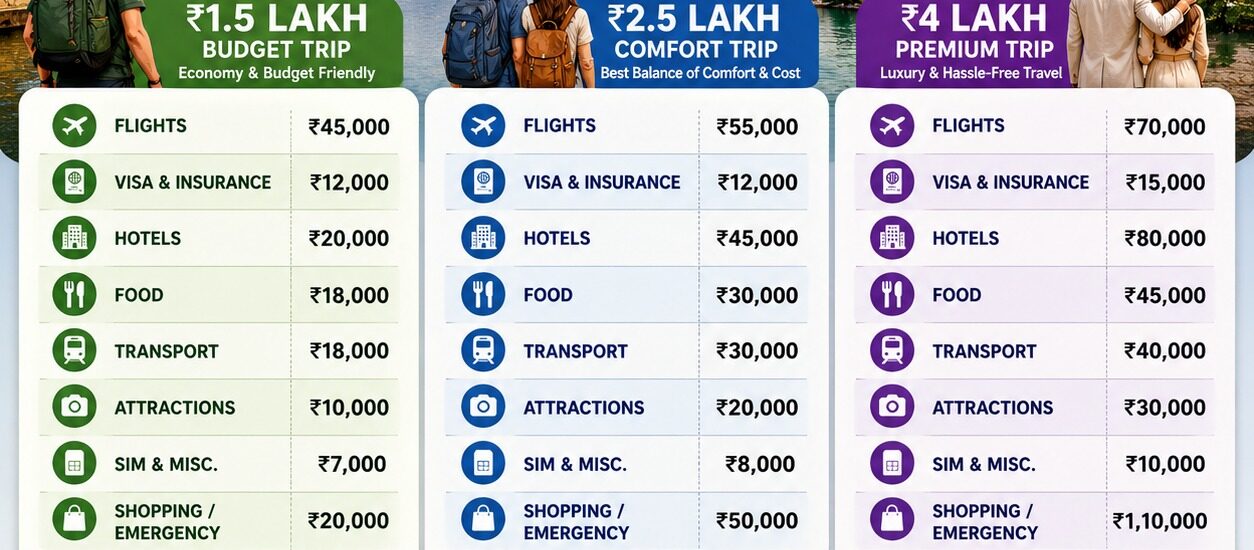
Europe Trip Budget at a Glance
|
Expense |
₹1.5 Lakh Budget |
₹2.5 Lakh Budget |
₹4 Lakh Budget |
|
International Flights |
₹45,000 |
₹55,000 |
₹70,000 |
|
Visa & Insurance |
₹12,000 |
₹12,000 |
₹15,000 |
|
Hotels |
₹20,000 |
₹45,000 |
₹80,000 |
|
Food |
₹18,000 |
₹30,000 |
₹45,000 |
|
Transport |
₹18,000 |
₹30,000 |
₹40,000 |
|
Attractions |
₹10,000 |
₹20,000 |
₹30,000 |
|
SIM & Misc. |
₹7,000 |
₹8,000 |
₹10,000 |
|
Shopping/Emergency |
₹20,000 |
₹50,000 |
₹1,10,000 |
|
Total |
₹1.50 Lakh |
₹2.50 Lakh |
₹4 Lakh |
The biggest difference between these budgets is not simply the number of countries. It is the quality of flights, hotels, food, transportation and activities.
1. ₹1.5 Lakh Europe Trip Budget
A ₹1.5 lakh budget is possible, but you’ll need to travel strategically.
This budget works best for:
- 5–7 days
- 1–2 countries
- Hostels or budget hotels
- Early flight bookings
- Public transportation
- Free/low-cost attractions
- Limited shopping
Trying to cover 5–6 European countries with only ₹1.5 lakh would make the trip extremely difficult.
₹1.5 Lakh Budget Breakdown
Flights — ₹45,000
Look for:
- Economy flights
- Connecting flights
- Flexible dates
- Off-season travel
- Early booking
If you find a significantly cheaper airfare, you can shift the saved money towards accommodation and sightseeing.
Visa & Insurance — ₹12,000
Keep a separate amount for:
- Schengen visa-related expenses
- Service charges
- Travel insurance
Exact costs can change, so check the current official requirements before applying.
Accommodation — ₹20,000
At this budget, consider:
- Hostels
- Budget hotels
- Guesthouses
- Shared rooms
- Accommodation outside the city centre
For example, staying near a metro station outside the main tourist centre can sometimes provide better value.
Food — ₹18,000
You can control food costs by combining:
- Supermarket food
- Bakeries
- Affordable cafés
- Fast-casual restaurants
- Occasional Indian restaurants
Cooking facilities at hostels or apartments can also help reduce expenses.
Transport — ₹18,000
Use:
- Metro
- Public buses
- Regional trains
- Advance-purchase train tickets
Avoid taking taxis unless necessary.
Attractions — ₹10,000
Focus on a few major attractions and use free sightseeing for the rest.
Examples:
- Walking tours
- Public squares
- Parks
- Viewpoints
- Historic neighbourhoods
SIM & Miscellaneous — ₹7,000
Keep money aside for:
- SIM/eSIM
- Small purchases
- Toiletries
- Unexpected expenses
Shopping/Emergency — ₹20,000
Don’t spend your entire budget before the trip ends.
Keep an emergency reserve.
2. ₹2.5 Lakh Europe Trip Budget
₹2.5 lakh is a much more comfortable budget for a first Europe trip.
You can generally afford:
- 8–12 days
- 2–3 countries
- Budget or mid-range hotels
- Better transportation
- More attractions
- Restaurant meals
- Some shopping
A route such as:
Paris → Switzerland → Italy
can become much more realistic with careful planning.
₹2.5 Lakh Budget Breakdown
Flights — ₹55,000
You have more flexibility than with a ₹1.5 lakh budget.
Consider:
- Better flight timings
- Fewer inconvenient connections
- Open-jaw flights
- Multiple departure airports
For example:
India → Paris
and
Rome → India
can save time compared with returning to Paris.
Visa & Insurance — ₹12,000
Keep this as a separate mandatory travel expense.
Accommodation — ₹45,000
You can consider:
- 3-star hotels
- Private hostel rooms
- Budget boutique hotels
- Apartments
- Hotels slightly outside city centres
Choose accommodation based on public transport access rather than simply selecting the cheapest room.
Food — ₹30,000
A combination of:
- Breakfast at accommodation
- Supermarket meals
- Local restaurants
- Indian restaurants
- Cafés
can provide a good balance.
Transport — ₹30,000
You can use:
- High-speed trains
- Regional trains
- Metro
- Buses
- Occasional budget flights
Book popular train routes in advance whenever possible.
Attractions — ₹20,000
This gives you room for several major attractions.
For example:
- Eiffel Tower
- Louvre
- Colosseum
- Vatican Museums
- Swiss mountain excursion
The exact combination depends on your itinerary.
SIM & Miscellaneous — ₹8,000
Include:
- eSIM
- Local transport top-ups
- Small purchases
- Travel accessories
Shopping/Emergency — ₹50,000
This gives you a comfortable reserve for shopping and unexpected expenses.
You don’t have to spend the entire amount.
3. ₹4 Lakh Europe Trip Budget
A ₹4 lakh budget provides considerably more flexibility.
You can potentially plan:
- 10–15 days
- 3–4 countries
- 3–4 star hotels
- Better flight schedules
- More expensive attractions
- Restaurant meals
- Premium train journeys
- Shopping
This budget is particularly suitable for couples, families or travellers who don’t want to constantly monitor every expense.
₹4 Lakh Budget Breakdown
Flights — ₹70,000
You can prioritize:
- Better flight timings
- Fewer connections
- Convenient arrival/departure airports
- Better baggage allowance
However, even with a ₹4 lakh budget, comparing flight prices is worthwhile.
Visa & Insurance — ₹15,000
Keep sufficient room for visa-related expenses and comprehensive travel insurance.
Hotels — ₹80,000
You can consider:
- 3–4 star hotels
- Better locations
- Private rooms
- Larger rooms
- Better amenities
For Switzerland, hotel costs can be significantly higher than in some other European destinations.
Food — ₹45,000
You can comfortably combine:
- Local restaurants
- Indian restaurants
- Cafés
- Supermarkets
- Occasional premium dining
Transport — ₹40,000
You can use:
- High-speed trains
- Premium rail options where worthwhile
- Metro
- Regional transport
- Selected flights
Attractions — ₹30,000
You have room for more paid experiences.
Examples include:
- Museums
- Guided tours
- River cruises
- Mountain excursions
- Historic sites
- Premium experiences
SIM & Miscellaneous — ₹10,000
Include:
- eSIM
- Local transport
- Travel accessories
- Small emergencies
Shopping/Emergency — ₹1,10,000
This provides a large flexible reserve.
You can use part of it for:
- Shopping
- Souvenirs
- Extra activities
- Unexpected hotel/transport costs
- Emergency expenses
₹1.5 Lakh vs ₹2.5 Lakh vs ₹4 Lakh
₹1.5 Lakh
Best for: Backpackers and budget travellers
Duration: 5–7 days
Style: Hostel + public transport + limited paid attractions
Countries: 1–2
Main goal: Experience Europe at the lowest practical cost
₹2.5 Lakh
Best for: First-time Europe travellers
Duration: 8–12 days
Style: Comfortable hotels + trains + restaurants
Countries: 2–3
Main goal: Balance comfort and budget
₹4 Lakh
Best for: Couples, families and premium travellers
Duration: 10–15 days
Style: Better hotels + convenient transport + more experiences
Countries: 3–4+
Main goal: Comfortable European holiday
How Much Does a Europe Flight Cost From India?
International airfare is usually one of the largest expenses.
Prices vary depending on:
- Departure city
- Destination
- Travel season
- Airline
- Baggage
- Number of stops
- Booking date
Delhi and Mumbai generally offer many international connections, which can sometimes provide more competitive fares.
Don’t look only at the cheapest ticket.
Compare the total cost, including baggage and inconvenient long layovers.
How to Reduce Flight Costs
1. Be Flexible With Dates
Flying a few days earlier or later can sometimes make a major difference.
2. Compare Multiple Airports
Consider different European arrival cities when practical.
3. Consider Open-Jaw Flights
For example:
India → Paris
Rome → India
This can reduce unnecessary backtracking.
4. Book Early
Popular travel periods can become expensive as availability decreases.
Europe Hotel Budget
Accommodation can consume a large part of your travel budget.
Prices vary significantly between cities.
Generally, major tourist destinations such as:
- Paris
- Zurich
- Geneva
- Venice
- Amsterdam
- London
can be expensive.
Budget-conscious travellers can look at neighbourhoods outside the main tourist centre with convenient metro or train access.
How to Save Money on Hotels
Stay Near Public Transport
A cheaper hotel close to a metro station can be more useful than an expensive hotel in the city centre.
Compare Multiple Platforms
Check:
- Room price
- Taxes
- Breakfast
- Cancellation policy
- Tourist tax
- Cleaning fees where applicable
Travel During Shoulder Season
April–June and September–October can offer a good balance between weather and demand, depending on the destination.
Europe Food Budget
Food costs can vary significantly.
A budget traveller can reduce expenses with:
Supermarket breakfast → affordable lunch → local dinner
Instead of eating at expensive restaurants three times every day.
Budget Food Strategy
Buy:
- Bread
- Fruit
- Yogurt
- Sandwiches
- Salads
- Snacks
- Drinks
from supermarkets.
Save restaurant spending for experiences you actually want to enjoy.
Europe Transportation Budget
Transportation depends heavily on your route.
For city travel, use:
- Metro
- Bus
- Tram
- Regional trains
For intercity travel, compare:
- High-speed train
- Regional train
- Budget airline
- Bus
Don’t automatically choose a flight simply because it appears cheaper.
Once you add airport transfers, baggage and travel time, the train may be better value.
Is a Eurail Pass Worth It?
It depends on your itinerary.
A Eurail Pass can be useful when you’re taking many train journeys across several countries.
However, if you have only a few journeys, individual advance-purchase tickets may sometimes be cheaper.
Always compare the total cost before purchasing a rail pass.
How to Save ₹20,000–₹50,000 on a Europe Trip
Small savings across several categories can make a big difference.
Save on Flights
Travel during less expensive periods and compare multiple dates.
Save on Hotels
Stay outside the most expensive tourist zones.
Save on Food
Use supermarkets and affordable local restaurants.
Save on Transport
Use public transport and book long-distance trains early.
Save on Attractions
Mix paid attractions with free sightseeing.
Save on Currency
Avoid unnecessary currency exchange fees.
Save on Shopping
Set a shopping budget before leaving India.
Hidden Costs to Remember
Many travellers calculate flights and hotels but forget smaller expenses.
Remember:
- Tourist taxes
- Airport transfers
- Local transport
- Baggage fees
- ATM fees
- Foreign transaction fees
- Attraction reservations
- Train seat reservations where applicable
- SIM/eSIM
- Laundry
- Tips
- Emergency expenses
These costs can add up quickly.
Europe Trip Budget for Couples
If you’re travelling as a couple, some costs can be shared.
For example:
- Hotel room
- Taxi
- Apartment
- Some transfers
However, food, attraction tickets and flights are generally charged per person.
A comfortable couple’s trip can therefore require considerably more than ₹2.5 lakh total, especially during peak season.
Europe Trip Budget for Families
Families should account for:
- Multiple flight tickets
- Larger hotel rooms
- Child attraction tickets
- Food
- Local transportation
- Luggage
Apartment-style accommodation with kitchen facilities can sometimes help families control food costs.
Best Europe Destinations for Budget Travellers
If your budget is limited, consider destinations where accommodation and food can be more affordable than the most expensive European capitals.
Depending on your itinerary, you may explore:
- Portugal
- Hungary
- Poland
- Czech Republic
- Greece
- Parts of Spain
Costs still vary considerably by city and season.
Best Europe Destinations for Premium Travel
For travellers with a ₹4 lakh+ budget, destinations such as:
- Switzerland
- France
- Italy
- Norway
- Iceland
- Austria
can provide excellent premium experiences, although some of these destinations can also be among Europe’s more expensive options.
Sample ₹2.5 Lakh Europe Itinerary
A practical example could be:
Day 1: India → Paris
Day 2: Paris sightseeing
Day 3: Paris sightseeing
Day 4: Paris → Switzerland
Day 5: Lucerne
Day 6: Interlaken
Day 7: Switzerland → Milan
Day 8: Milan
Day 9: Milan → Venice
Day 10: Venice
Day 11: Venice → Rome
Day 12: Rome → India
This itinerary is only an example. Your actual route should be adjusted according to flight schedules, visa itinerary, train availability and personal preferences.
Europe Budget Planning Formula
A simple way to plan your trip is:
Total Budget = Flights + Visa + Insurance + Hotels + Food + Transport + Attractions + SIM + Shopping + Emergency Fund
Don’t allocate 100% of your budget to bookings.
Always keep an emergency reserve.
Recommended Budget for First-Time Indian Travellers
If this is your first Europe trip, ₹2.5 lakh per person is a reasonable target for a carefully planned 8–12 day trip.
It provides a better balance between:
Cost + Comfort + Experiences
If you’re a strict budget traveller, ₹1.5 lakh can work for a shorter trip.
If you want better hotels, more destinations and additional experiences, ₹4 lakh gives you much more flexibility.
Final Europe Budget Checklist
Before booking your trip, calculate:
- International flights
- Schengen visa expenses
- Travel insurance
- Hotel costs
- Train/flight transportation
- Local transport
- Food
- Attraction tickets
- SIM/eSIM
- Currency exchange
- Shopping
- Emergency fund
Conclusion
A Europe trip from India doesn’t have to cost the same for everyone. With smart planning, you can build your holiday around your budget.
A ₹1.5 lakh trip is suitable for short, budget-focused travel.
A ₹2.5 lakh trip offers a comfortable balance between affordability and experiences.
A ₹4 lakh trip provides considerably more flexibility for better accommodation, transportation, attractions and shopping.
The key is to decide your budget before booking anything, then divide the money between flights, hotels, food, transportation and experiences.
Instead of asking, “How much does Europe cost?”, ask:
“What kind of Europe experience do I want for my budget?”
Once you answer that question, planning your European adventure becomes much easier.