
If you’re planning a multi-country trip across Europe, the Eurail Pass question comes up almost immediately. It sounds appealing on paper — one pass, unlimited borders, no separate ticket booking. But whether it actually saves you money depends heavily on how you plan to travel. Here’s the honest breakdown.
What the Eurail Pass Actually Is
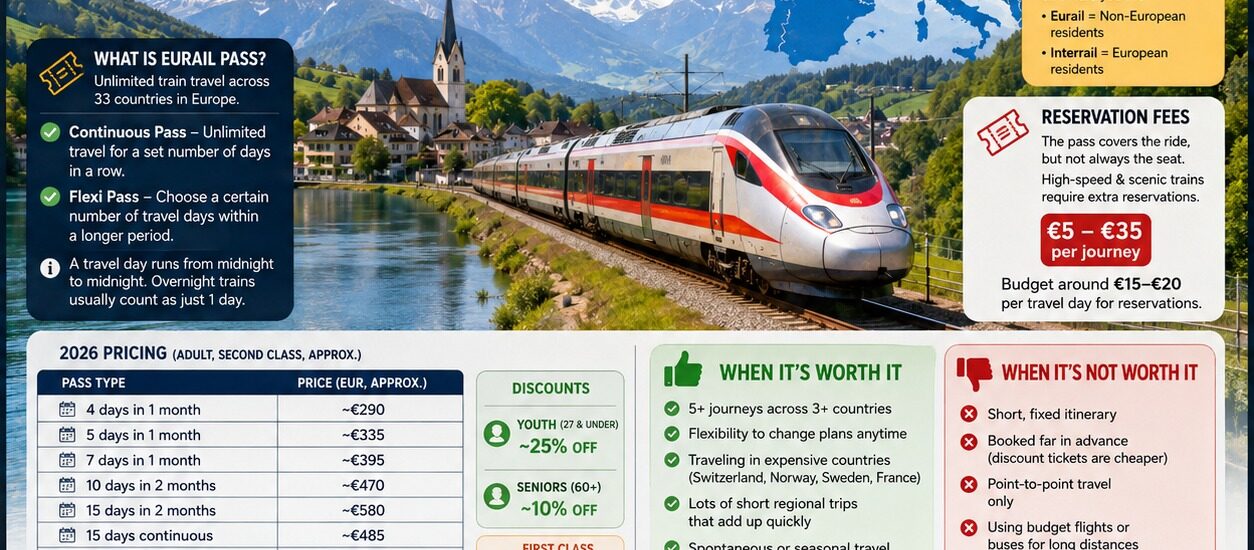
The Eurail Pass (called Interrail if you’re a European resident — same product, same network, different name based on where you live) covers rail travel across roughly 33 countries in Europe, including the UK, Switzerland, Norway, Turkey, and most of the EU.
There are two formats:
- Continuous Pass — unlimited travel for a fixed block of days (15 days, 22 days, 1 month, 2 months, or 3 months)
- Flexi Pass — a set number of travel days you can use within a longer window (e.g., 7 travel days within 1 month)
A “travel day” runs midnight to midnight in whichever country you board in, and overnight trains departing in the evening typically count as just one travel day even if you arrive the next morning.
2026 Pricing (Adult, Second Class, Approximate)
|
Pass Type |
Price (EUR, approx.) |
|
4 days in 1 month |
~€290 |
|
5 days in 1 month |
~€335 |
|
7 days in 1 month |
~€395 |
|
10 days in 2 months |
~€470 |
|
15 days in 2 months |
~€580 |
|
15 days continuous |
~€485 |
|
1 month continuous |
~€700 |
|
3 months continuous |
~€1,050 |
Youth travelers (27 and under on the first travel day) get roughly 25% off, and seniors (60+) get a smaller discount around 10%. First class runs about 25–30% more than these figures. Prices are revised yearly and discounted heavily during periodic flash sales (Black Friday in November, and often another round in February or March), so it’s worth timing a purchase around those windows rather than buying at list price.
The Catch: Reservation Fees
This is where a lot of the “surprise cost” comes from. The pass covers the ride, but not always the seat. High-speed and scenic trains — French TGVs, Italian Frecciarossa, Spanish AVE, most night trains — require a separate paid reservation on top of the pass, typically running anywhere from €5 to €35 per journey. Budgeting roughly €15–€20 per travel day for reservations is a reasonable rule of thumb if your route includes these train types.
Germany, Austria, and most regional trains in Central/Eastern Europe, by contrast, rarely need reservations — so a pass used mostly in those countries carries far fewer hidden costs.
When It’s Genuinely Worth It
- You’re making 5+ journeys across 3+ countries and your route isn’t fully fixed yet
- You want flexibility — the ability to catch an earlier or later train without rebooking or paying a change fee
- You’re traveling in countries with expensive point-to-point fares — Switzerland, Norway, Sweden, and France in particular tend to have steep individual ticket prices, especially in peak summer or around holidays
- You’re combining several shorter regional/suburban hops — these fares are individually small but add up fast, and the pass absorbs all of them
When It’s Probably Not Worth It
- You have a short, fixed itinerary — say, three specific cities booked well in advance. Point-to-point advance tickets, especially on Spanish or French high-speed lines, are often cheaper once booked a couple of months out, even after adding reservation fees.
- You’re going point-to-point without side trips — a single one-way ticket almost always beats the daily-average cost of a pass.
- You’re traveling mostly by budget airline or bus for long hops — the pass only pays for itself if trains are your primary mode.
A Real Numbers Example
On a genuinely mixed itinerary — say Amsterdam → Paris → Zurich → Milan → back to Amsterdam — individually booked tickets can come out cheaper if booked far enough in advance, since discount fares undercut the pass’s daily average. But add in a scenic or high-fare leg (like the Glacier Express in Switzerland, where the point-to-point ticket alone can run over 150 CHF), and the pass suddenly saves a meaningful amount on that single leg alone. This is the core pattern: the pass wins big on expensive, spontaneous, or scenic routes, and loses to advance-purchase single tickets on cheap, predictable ones.
Continuous vs. Flexi: Which to Pick
Flexi passes are usually the smarter buy for most trip styles, because continuous passes burn a “travel day” even on days you’re resting in one city or taking a short local hop. A 10-day flexi pass spread across two months lets you choose exactly which days you ride; a 15-day continuous pass forces you to use all 15 days whether you’re moving or not.
Bottom Line
The Eurail Pass earns its price back when your trip involves multiple countries, flexible dates, and at least a few expensive or spontaneous legs. It’s less about pure math and more about not having to plan every ticket in advance — you’re buying flexibility as much as transport.
If your itinerary is locked in and mostly budget-fare-friendly, book individual tickets ahead of time instead. If you’re still figuring out your route as you go, especially across Western/Northern Europe, the pass is very likely worth it.
Note: Prices and country coverage are revised periodically — check Eurail’s official site before buying, since promotions can shift the numbers significantly.