
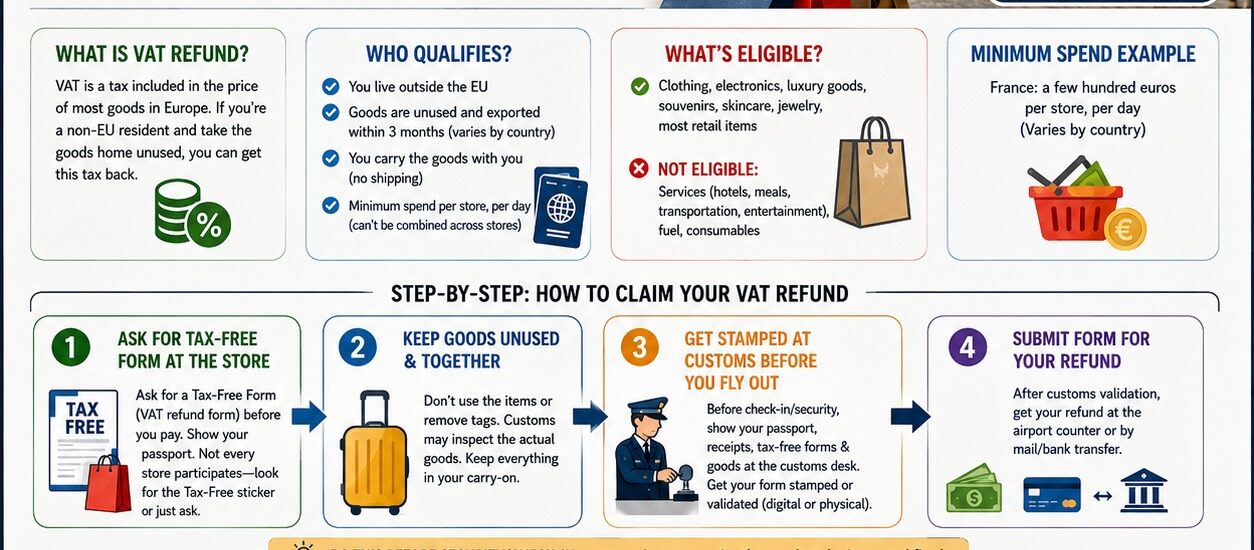
Shopping in Europe comes with a perk a lot of travelers never actually use: getting back the Value-Added Tax (VAT) on what you buy. VAT in European countries typically runs between 17% and 27% depending on the country — and if you’re a non-EU resident, a meaningful chunk of that is refundable. Here’s exactly how the process works, who qualifies, and how to avoid the common mistakes that cause people to lose their refund.
What Is VAT, and Why Can You Get It Back?
VAT is a consumption tax built into the price of almost everything you buy in Europe — clothing, electronics, souvenirs, skincare, jewelry. It’s similar to sales tax in the US, except it’s already included in the sticker price rather than added at checkout. Because VAT is meant to tax domestic consumption, non-EU residents who buy goods and take them home unused are entitled to get that tax back — the logic being that the goods weren’t actually consumed in the country you bought them in.
Who Qualifies for a VAT Refund?
- You must live outside the EU — your permanent or habitual residence needs to be outside the European Union (or outside the specific country’s VAT zone, for non-EU European countries like Switzerland or the UK’s own separate rules).
- The goods must be unused and exported within a set window — usually within three months of purchase, though this varies slightly by country.
- You must carry the goods with you — items shipped home by mail or courier don’t qualify. It has to leave the country in your own luggage.
- A minimum spend applies per store, per day — and importantly, this minimum can’t be combined across multiple shops. If you’re doing serious shopping, it’s more efficient to hit the minimum at one retailer than spread purchases thin across several. In France, for example, the minimum is a few hundred dollars per store per day.
What’s Eligible — and What Isn’t
Eligible: Fashion, electronics, luxury goods, souvenirs, skincare and beauty products, jewelry, and most retail merchandise.
Not eligible: Services like hotel stays, meals, transportation, or entertainment — these are considered consumed within the country and don’t qualify. Fuel and other travel consumables are also excluded.
Step-by-Step: How to Actually Claim It
Step 1: Ask for a Tax-Free Form at the Store
When you’re checking out, ask for a Tax-Free Form (sometimes just called a VAT refund form) before you pay. Not every store participates — look for a “Tax-Free Shopping” sticker near the register, or just ask. You’ll need to show your passport at this point, since the form is tied to your identity and residency.
Step 2: Keep Everything Unused and Together
Don’t wear the clothes, remove the tags, or use the electronics before you leave. Customs officers can ask to inspect the actual items, not just the receipt, so keep everything easily accessible in your carry-on rather than buried in checked luggage.
Step 3: Get Stamped at Customs Before You Fly Out
This is the step most people get wrong. Before you check in for your flight (or in some cases, before you check your bags), find the customs desk at the airport and present your passport, receipts, tax-free forms, and the actual goods. They’ll stamp or digitally validate the form — some major airports now use a digital export validation system instead of a physical stamp. Do this before security/check-in, not after, since some airports require the goods to be inspected first.
Step 4: Submit the Form for Your Refund
After customs validates your export, you can usually get your refund one of two ways:
- Immediately at a refund counter in the airport (usually via the same company that issued your form — Global Blue, Planet, and similar providers run most of these desks)
- By mailing the stamped form in a prepaid envelope if there’s no refund counter, or if you prefer a bank transfer over cash
Refunds can be paid to a credit card, via bank transfer, or in cash at the airport counter, though cash refunds sometimes come with a worse exchange rate or added fee.
Common Mistakes That Cost People Their Refund
- Not asking for the form at the time of purchase. You generally can’t go back for it later.
- Using the item before leaving the country. Customs can deny the stamp if goods look used.
- Packing the goods in checked luggage before getting them inspected. Always get the customs stamp before your bags disappear into the hold.
- Missing the customs desk at a connecting airport. If your flight home connects through another EU country, you need to get the export stamp at the last EU airport you leave from — not the one you originally shopped in.
- Assuming refunds are automatic. Nothing happens without you actively completing the paperwork and customs step — unclaimed refunds are extremely common simply because travelers don’t realize they’re eligible.
A Quick Tip on Getting the Best Value
Some VAT refund providers now offer app-based verification (verify your passport once in the app, rather than at every single store), which speeds up the process considerably if you’re shopping across multiple stops. It’s worth checking whether your destination country’s main refund provider offers this before your trip.
Also worth knowing: the refund you receive is rarely the full VAT rate. Refund companies typically deduct a processing fee, so the amount you get back is usually a bit less than the sticker VAT percentage — still worth claiming, just don’t expect the full 20%+ back in your pocket.
Bottom Line
If you’re planning any real shopping on a European trip — clothing, electronics, or souvenirs — the VAT refund is close to free money as long as you follow the process: ask at the store, keep goods unused, get stamped at customs before you fly home, and submit the form. Skip any one of these steps and the refund disappears.