
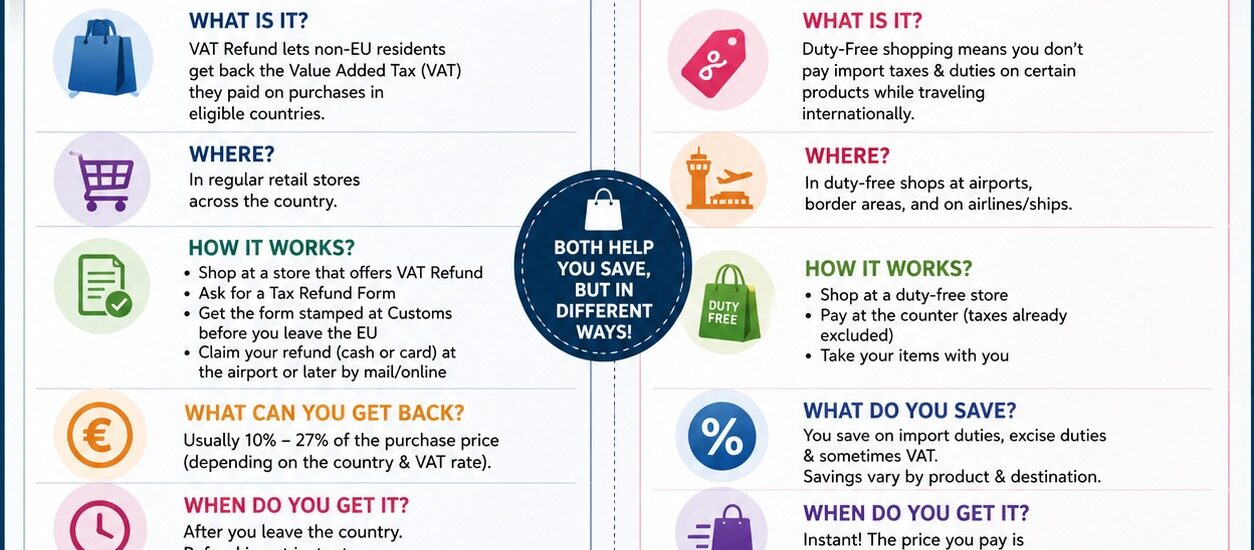
Ask ten travelers to explain the difference between duty-free and a VAT refund, and you’ll probably get ten different answers — most of them wrong. It’s one of the most mixed-up concepts in travel shopping, and honestly, it’s an easy mistake to make. Both involve the words “tax” and “savings,” both happen when you’re traveling internationally, and both can genuinely save you money. But they work in completely different ways, at completely different points in your trip. Here’s the actual breakdown.
Duty-Free: Tax Never Gets Added in the First Place
Duty-free shops — the ones you find airside at the airport, past security — sell goods without the usual duties and VAT baked into the price. The tax simply isn’t charged at the point of sale, because you’re technically buying the item before you’ve “entered” the country in a customs sense, or you’re already leaving it.
That’s the whole mechanism: no tax added, so no tax to claim back later. What you see on the shelf is what you pay. Simple.
The catch most people don’t think about: duty-free isn’t automatically cheap. It just means you’re not paying tax. If the base price of the item was already high, or if the airport marks things up because it knows it has a captive audience, the “savings” can be smaller than they look. It’s genuinely worth comparing prices with your home country before assuming an airport deal is a real deal — especially for electronics, watches, and spirits, where prices vary a lot city to city.
VAT Refund: You Pay the Tax First, Then Get (Some of) It Back
A VAT refund works the opposite way. You walk into a regular shop in a regular city — not an airport — and you pay full price, tax included, just like a local would. The difference is that if you’re a non-EU resident and you’re taking the goods home unused, you’re entitled to reclaim most of that tax afterward.
This means:
- You need to shop at a participating store and ask for a tax-free form at checkout.
- You need to hit that country’s minimum purchase threshold — this varies a lot, from no minimum at all in Spain to over €100 in France.
- You need to get that form validated by customs before you leave the EU, with the goods still unused.
- You then wait — sometimes weeks — for the refund to actually land, whether as cash at the airport, a credit card refund, or a bank transfer.
So unlike duty-free, VAT refund shopping isn’t instant. It’s a process with paperwork attached, and a service fee usually gets deducted along the way, so you never get back 100% of what you paid in tax. But because it applies to purchases made anywhere in the city — not just what’s sitting on an airport shelf — it opens up basically your entire shopping trip to potential savings, not just what happens to be near your gate.
The Core Difference, in One Line
Duty-free = tax was never added, and you walk out with the discount immediately. VAT refund = tax was added and paid, and you claim part of it back later, with paperwork.
When Does Each One Actually Make Sense?
Duty-free makes sense when:
- You’re buying something small, portable, and airport-shelf-friendly — perfume, alcohol, chocolate, cosmetics.
- You want instant savings with zero paperwork.
- You’re not fussy about brand or selection — airport stock is limited compared to a real store.
VAT refund makes sense when:
- You’re making a bigger purchase — designer clothing, jewelry, electronics, watches — where the tax saved is actually meaningful in real money.
- You have the patience to keep receipts, fill out a form, and stand in a customs line before your flight.
- You’re shopping across a whole city or region, not just what’s available at the airport.
A Mistake Worth Avoiding
Don’t assume that because you got a VAT refund form from a city store, you can also swing by duty-free and expect the same tax treatment — they’re unrelated systems, run by different rules and often different companies entirely. And don’t assume duty-free prices are lower just because there’s no tax on them; check before you buy, because sometimes the “regular” store with a VAT refund actually works out cheaper once you’ve claimed the refund back.
Bottom line: duty-free is about what you don’t pay in the moment. A VAT refund is about getting back what you already paid. Knowing which one you’re dealing with — and when each one is actually worth the effort — is what separates a smart shopping trip from an overpriced souvenir haul.